

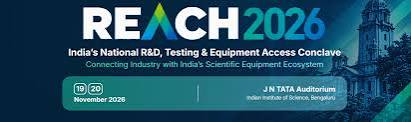
REACH 2026, India’s National Research and Development, Testing and Equipment Access Conclave, brought together stakeholders from industry, start-ups, research institutions and scientific facilities to strengthen access to the country’s research infrastructure.
The two-day event, held on October 19 and 20, is an initiative of the Indian Science, Technology and Engineering Facilities Map (I-STEM), supported by the Office of the Principal Scientific Adviser to the Government of India.
The conclave focuses on connecting organisations that need specialised scientific equipment and testing services with institutions that already possess these facilities. Improving access to existing infrastructure can help researchers and businesses reduce duplication, manage development costs and make better use of publicly funded scientific resources.
Participants targeted by the initiative include micro, small and medium enterprises, start-ups, corporate research and development centres, academic institutions, testing laboratories, calibration facilities and scientific equipment manufacturers.
Access to specialised instruments can be a major challenge for early-stage companies and smaller research teams. Purchasing and maintaining advanced equipment may require substantial investment, while some facilities may be used only for limited periods. Shared access can provide an alternative, allowing users to conduct experiments and testing without having to establish complete laboratories of their own.
I-STEM operates as a digital platform intended to make India’s research facilities more discoverable and accessible. By connecting users with available equipment and services, the system seeks to improve coordination between institutions and potential users.
The REACH conclave also provides an opportunity for industry and research organisations to discuss practical requirements, collaboration opportunities and ways to improve the use of scientific facilities.
Closer cooperation between laboratories and industry can support product development, quality testing, certification and the translation of research into commercial applications. For start-ups, access to suitable infrastructure can be particularly important during the early stages of technology development.
The initiative reflects a broader effort to strengthen India’s research ecosystem by making existing capabilities more accessible. Its long-term impact will depend on effective facility-sharing arrangements, transparent access procedures and sustained participation from research institutions and industry.


Comment here