

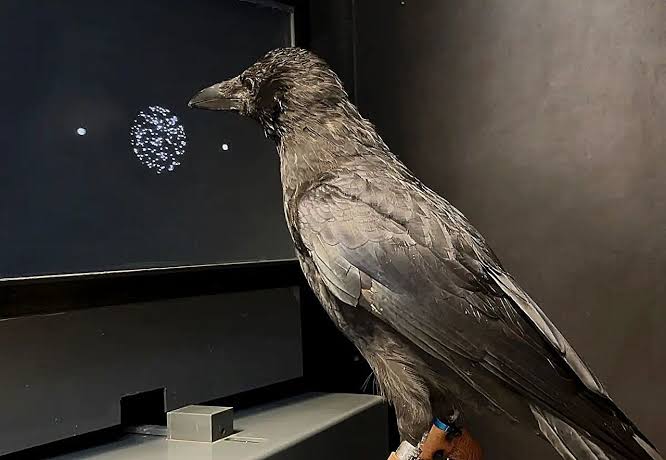
NEW DELHI: Crows can make certain visual decisions in an average of just 235 milliseconds, nearly twice as fast as humans and monkeys in comparable tasks, according to research by scientists at the University of Tübingen in Germany.
The study, published in the journal Science on October 22, examined how carrion crows process visual information and make decisions. The findings offer new insights into the functioning of bird brains and the different ways animals have evolved to process information.
During the experiment, researchers trained two carrion crows to complete a visual recognition task using a touchscreen. The birds were shown patterns of moving dots and had to identify whether most of the dots were travelling towards the left or right.
They indicated their choices by pecking a target on the corresponding side of the screen. The difficulty of the task varied depending on how clearly the dots moved in one direction.
The crows completed the task in an average of 235 milliseconds while maintaining a high level of accuracy. When the movement was clear, their accuracy approached 100 per cent.
Researchers also recorded the activity of neurons in a brain region known as the nidopallium caudolaterale. This area plays an important role in information processing and decision-making in birds and performs functions comparable to those associated with the prefrontal cortex in humans.
The recordings showed that the birds’ brains began distinguishing between movement directions around 70 milliseconds after the visual patterns appeared.
Scientists believe the ability to process visual information rapidly may be connected to the demands of flight and foraging. Birds need to identify obstacles, respond to moving objects and locate food with precision.
The research also highlights that sophisticated decision-making does not necessarily require a brain structure identical to that of humans and other mammals.
However, the experiment involved only two crows, and further research will be needed to understand how widely these findings apply across bird species.



Comment here