

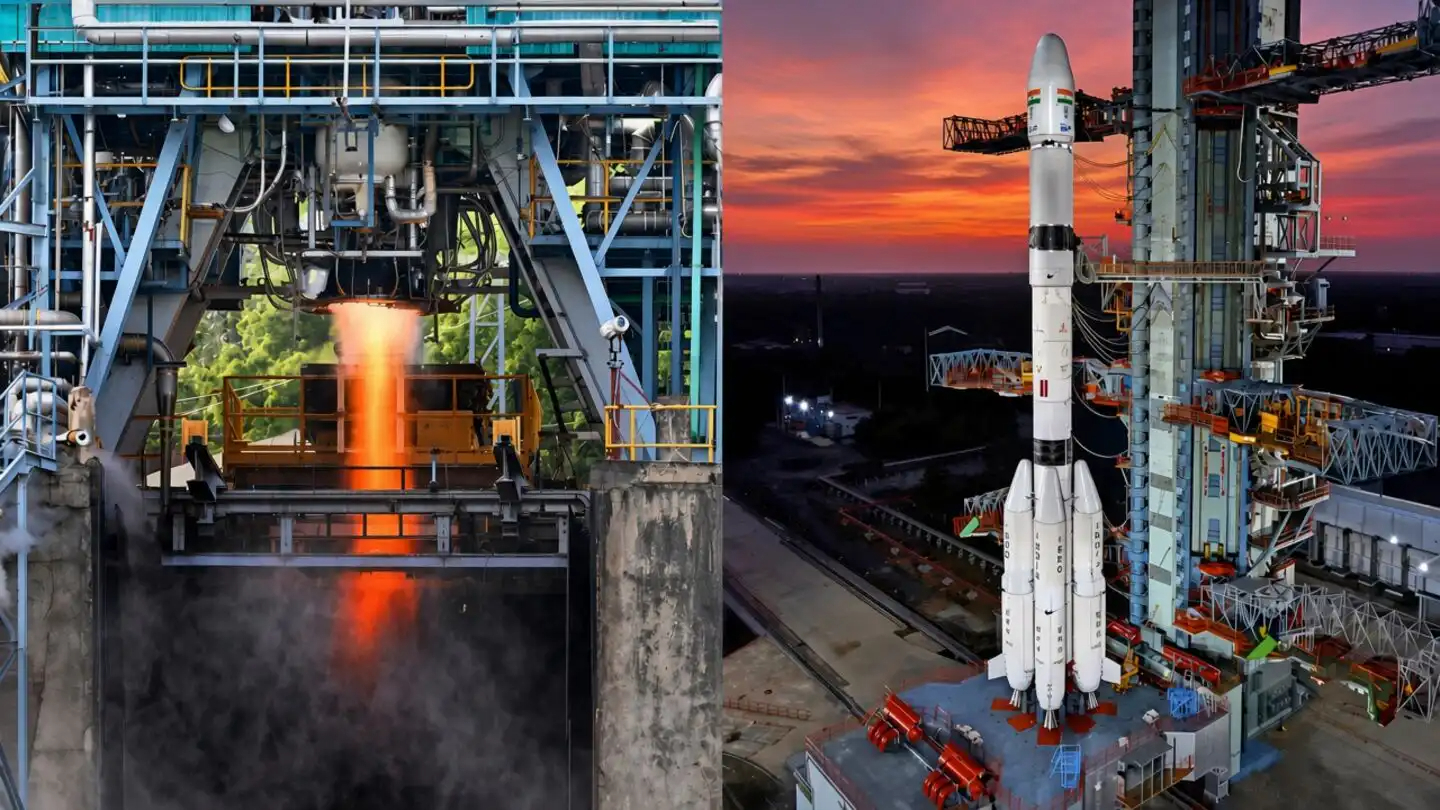
Mahendragiri: The Indian Space Research Organisation (ISRO) has successfully completed a 200-second flight acceptance test of the cryogenic engine identified for its upcoming GSLV-F19 mission.
The test was conducted on November 5, 2026, at the ISRO Propulsion Complex in Mahendragiri, Tamil Nadu. ISRO announced the result on November 10, with further reports appearing on November 11.
According to the space agency, the ignition of both the Main Engine and the Gas Generator took place as expected. During steady-state operation, the engine performed normally and remained consistent with the expected performance levels.
The test continued for 200 seconds, and ISRO described the overall performance as satisfactory and in line with pre-test predictions.
The engine will now be inducted into the cryogenic stage of the GSLV-F19 launch vehicle. The mission is planned to carry the NVS-04 navigation satellite, which is part of India’s Navigation with Indian Constellation (NavIC) system.
Cryogenic engines are an important part of launch vehicles because they use propellants stored at extremely low temperatures to generate the thrust required for placing heavier satellites into higher orbits.
NavIC is India’s independent satellite-based navigation system, designed to provide positioning, navigation and timing services across the country and an area extending beyond its borders.
The upcoming NVS-04 satellite is expected to strengthen the existing navigation constellation and support the continuity of these services.
The successful engine test marks another preparatory milestone for the GSLV-F19 mission. The engine will undergo integration into the launch vehicle’s cryogenic stage as the space agency advances work towards the next navigation satellite launch.


Comment here