

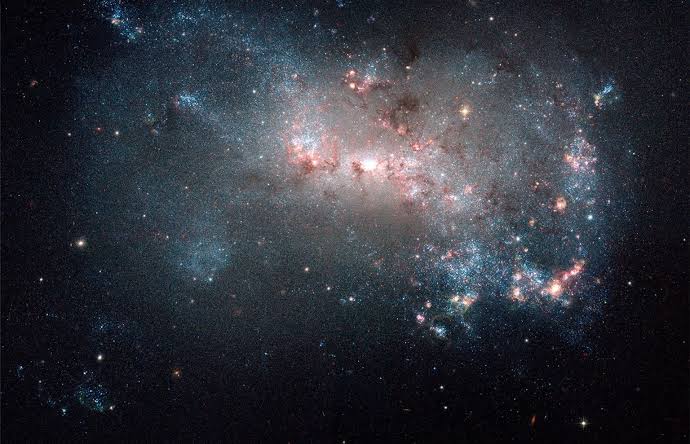
WASHINGTON: Observations from NASA’s Hubble Space Telescope have revealed that nearby dwarf galaxies retain only a small fraction of the oxygen produced by their stars, offering new insights into how galaxies evolve and distribute elements across the universe.
The research, part of the Galaxies Losing Oxygen via Winds (GLOW) project, examined 37 nearby dwarf galaxies. Scientists found that much of the oxygen expected to remain within these galaxies appears to have been expelled into surrounding space.
Oxygen is produced inside stars and released through stellar processes. It is one of the most abundant elements in the universe after hydrogen and helium and plays an important role in understanding the chemical evolution of galaxies.
Researchers used archival observations from Hubble, along with data from other astronomical facilities, to study the distribution of oxygen in stars, gas and dust.
The findings suggest that powerful galactic winds driven by massive stars and supernova explosions can remove oxygen from low-mass galaxies more efficiently than existing models predict.
When massive stars reach the end of their lives, supernova explosions release enormous amounts of energy. These events can drive gas and other material away from a galaxy, carrying newly produced elements into the surrounding environment.
Dwarf galaxies are particularly useful for studying these processes because their relatively low gravitational forces make it easier for energetic winds to eject material.
Scientists are continuing to investigate where the missing oxygen eventually ends up. Some of it may be present in gas surrounding galaxies, while other material may have travelled beyond their immediate environments.
The research could help improve scientific understanding of galaxy formation, star formation and the chemical enrichment of the universe.
The NASA announcement, dated November 2, highlights the importance of studying smaller galaxies to understand how elements produced by stars are distributed across cosmic space.



Comment here