

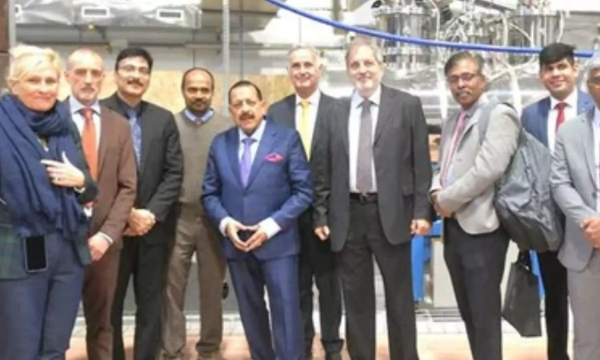
New Delhi: India has committed more than seven million euros towards the development of next-generation research beamlines at Italy’s Elettra Sincrotrone Trieste facility under the Elettra 2.0 programme.
The commitment was announced by Union Minister of State for Science and Technology Jitendra Singh during his visit to the Italian research facility on November 13. The Ministry of Science and Technology issued details of the announcement on November 14.
India’s contribution will be made over five years, beginning in the 2026-27 financial year. The collaboration is aimed at strengthening advanced research infrastructure and creating opportunities for Indian scientists and researchers to work with upgraded facilities.
Synchrotron facilities use high-energy electron beams to produce intense light, which researchers can use to study the structure and properties of materials at very small scales. Such facilities support work across several scientific disciplines, including physics, chemistry, biology and materials science.
The upgraded Elettra 2.0 infrastructure is expected to provide advanced research opportunities in areas such as advanced materials and structural biology, alongside chemistry and physics.
The project also places emphasis on developing scientific expertise and human resources. Access to advanced research infrastructure can help Indian research institutions undertake specialised experiments and strengthen international scientific partnerships.
The collaboration reflects India’s continued engagement with international research facilities and its efforts to expand scientific cooperation with European institutions.
The investment is expected to support access to modern experimental infrastructure and encourage research partnerships between scientists in India and Italy.
The initiative forms part of a wider effort to strengthen scientific collaboration and create opportunities for translating research findings into technology and innovation.


Comment here