

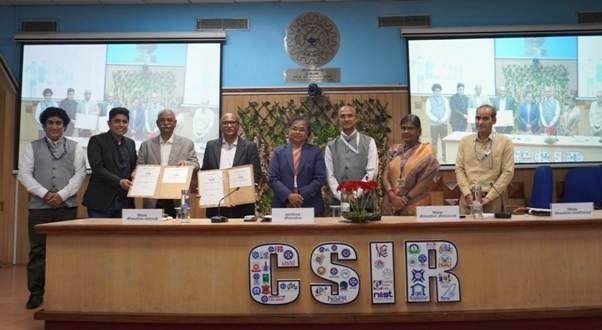
New Delhi: The Council of Scientific and Industrial Research (CSIR) has transferred several indigenous technologies to industry partners to accelerate their commercialisation and promote sustainable development.
The technology transfer programme and memorandum of understanding signing ceremony were held at CSIR headquarters in New Delhi on Thursday. The event brought together research laboratories and industry representatives to strengthen the connection between scientific research and practical industrial applications.
The programme was chaired by Dr N. Kalaiselvi, Secretary of the Department of Scientific and Industrial Research and Director General of CSIR.
Among the important technologies transferred was an Emergency Retrieval System for Power Lines developed by CSIR’s Structural Engineering Research Centre in Chennai. The lightweight and modular system is designed to help restore electricity transmission lines quickly following failures or disruptions. The technology was transferred to IFAB Global.
CSIR also transferred technologies for manufacturing eco-friendly bricks, hollow blocks and paver blocks using 100 per cent recycled aggregates and industrial waste. These products are intended to reduce dependence on natural construction materials and encourage the reuse of construction and demolition waste.
Another technology transferred for pilot-scale implementation was Ultra-High-Performance Concrete pavement technology. It offers high strength and durability and is designed to withstand heavy axle loads while reducing maintenance requirements.
The programme also included the transfer of MicroReAct-RAP, a cold micro-surfacing solution that incorporates up to 40 per cent reclaimed asphalt pavement. The technology is intended to reduce the use of fresh aggregates and bitumen-based materials in road construction.
A further development was the transfer of bio-bitumen technology, developed through collaboration between CSIR’s Central Road Research Institute and Indian Institute of Petroleum. The technology uses agricultural residues, including rice straw, to produce a biomass-derived material that can partially replace conventional petroleum-based bitumen.
CSIR also signed two MoUs to strengthen research and industry collaboration, including partnerships with the Global Automotive Research Centre and Parakhi Skill Systems.
Dr Kalaiselvi emphasised that scientific research must reach industries and society through effective commercialisation and wider adoption.
The initiative highlights India’s efforts to develop indigenous technologies that can support infrastructure development, resource efficiency and sustainable industrial growth.

Comment here