

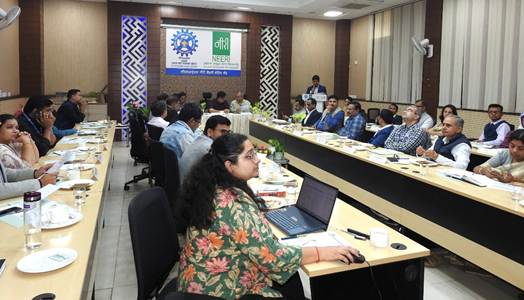
New Delhi: The CSIR-National Environmental Engineering Research Institute (CSIR-NEERI) organised a scientific brainstorming workshop in New Delhi to discuss practical solutions to air pollution and climate-related challenges across the Indo-Gangetic Plains.
The workshop, titled ‘Clean Air and Climate Resilience for the Indo-Gangetic Plains (IGP-CACR)’, was held at the institute’s Delhi Regional Centre in Naraina.
Scientists, policymakers and technical experts from different government departments and research institutions participated in the discussions. The objective was to identify science-based approaches that could support cleaner air and strengthen climate resilience in one of India’s most pollution-affected regions.
The discussions covered several important areas, including the identification of pollution sources, airshed management, the health impacts of air pollution and the vulnerability of the region to climate change.
Participants also examined the role of pollution-control technologies and artificial intelligence-based decision-support systems in improving environmental monitoring and planning.
The Indo-Gangetic Plains face multiple environmental challenges because of urbanisation, industrial activity, transport emissions, agricultural practices and changing climatic conditions. Air pollution in the region often extends beyond administrative boundaries, making coordination between different states and institutions important.
Experts discussed the need to strengthen cooperation among scientific organisations, government departments and technical agencies to develop solutions that can be implemented on the ground.
The workshop also highlighted the importance of connecting scientific research with policymaking. Better data, improved monitoring systems and the use of emerging technologies can help authorities understand pollution patterns and identify suitable interventions.
CSIR-NEERI’s initiative aims to encourage collaboration among research institutions and government agencies working on air quality and climate resilience.
The discussions are expected to contribute to further scientific engagement on pollution management and sustainable environmental planning across the Indo-Gangetic region.


Comment here