

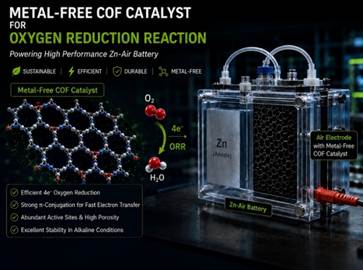
Indian scientists have developed a new metal-free porous material that could help reduce the cost of next-generation clean-energy technologies, including zinc-air batteries.
The material, developed by researchers from the S N Bose National Centre for Basic Sciences in Kolkata, the Institute of Nano Science and Technology in Mohali and SRM University, Amaravati, is designed to improve the oxygen reduction reaction, an important process in zinc-air batteries and fuel cells.
The material, called TTT-DHTD, is made from abundant elements including carbon, sulphur, nitrogen and hydrogen. Researchers developed it as an alternative to platinum-based catalysts that are widely used for oxygen-related electrochemical reactions.
Platinum is highly effective as a catalyst but is expensive and relatively scarce. Its cost and limited availability can create challenges for the large-scale deployment of technologies that depend on it.
Laboratory testing showed that the new material achieved around 96 per cent of the performance of commercial platinum catalysts. It also remained stable after 120 hours of continuous operation.
The researchers used advanced computer simulations to study the molecular structure of the material and understand why it performs efficiently. Its porous structure provides active sites where oxygen molecules can interact and undergo the reactions needed to generate electricity.
Zinc-air batteries have attracted interest because they use zinc, an abundant and relatively inexpensive material, and obtain oxygen directly from the surrounding air. They have potential applications in energy storage, portable power and clean transportation.
The researchers said replacing expensive platinum with an organic material made from more readily available elements could improve the economic prospects of such technologies.
The development also demonstrates the growing role of materials science and computational research in India’s clean-energy research efforts.
Further testing and development will be required before the material can be considered for large-scale commercial applications. However, the results provide a potential pathway towards cheaper and more sustainable catalysts for future energy-storage systems.


Comment here