

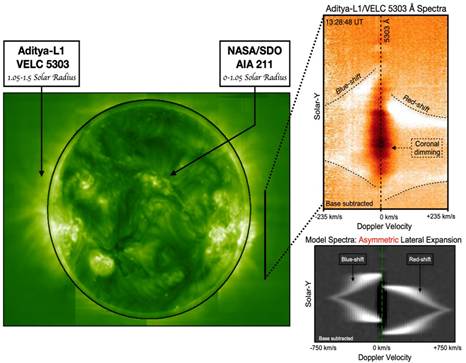
India’s first space-based solar observatory, Aditya-L1, has provided new insights into the behaviour of solar eruptions, helping scientists better understand the complex processes occurring in the Sun’s outer atmosphere.
Researchers from the Indian Institute of Astrophysics (IIA), Bengaluru, used observations from Aditya-L1 to study how a coronal mass ejection (CME) expands near the Sun.
The study found that the solar eruption did not expand uniformly like a symmetrical bubble. Instead, it developed an asymmetric shape, with different sections expanding at different rates.
The findings were published in The Astrophysical Journal Letters.
A coronal mass ejection is a large release of hot, magnetised plasma from the Sun’s outer atmosphere, known as the corona. These eruptions travel through space and, when directed towards Earth, can contribute to space-weather disturbances.
Such disturbances may affect satellites, communication systems and other space-based infrastructure.
The research team examined a solar eruption that occurred on August 5, 2024. Scientists combined spectroscopic observations from the Visible Emission Line Coronagraph (VELC), the primary payload onboard Aditya-L1, with images from NASA’s Solar Dynamics Observatory.
The team also developed a three-dimensional model to reconstruct the eruption’s geometry and movement.
The observations showed different spectral shifts indicating plasma moving both towards and away from the observer. These measurements helped scientists understand the eruption’s three-dimensional structure.
A model assuming symmetrical expansion could not reproduce the observed patterns. However, a model incorporating an inclined axis and asymmetric lateral expansion closely matched the observations.
The findings suggest that the shape of a solar eruption could influence its speed and interaction with the solar wind as it travels through space.
This may also affect the accuracy of predicting the arrival time of solar eruptions at Earth.
Aditya-L1, launched in September 2023, is positioned at the Sun-Earth L1 point, allowing it to continuously observe solar activity.
Scientists believe the study could open new avenues for analysing solar eruptions using observations from a single spacecraft.
Further investigations may help improve the understanding and modelling of space-weather events.
Source: Indian Institute of Astrophysics and ISRO.


Comment here