

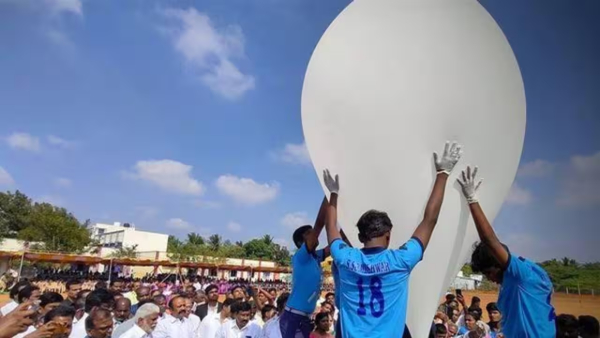
COIMBATORE: Fifty-five students from 11 government middle schools in Coimbatore district, Tamil Nadu, have taken part in an atmospheric research mission that sent a scientific payload approximately 35 kilometres above the Earth.
The initiative, known as Project Uyarvu, was launched on October 30 and provided students with practical exposure to scientific research beyond conventional classroom learning.
The mission used a helium-filled high-altitude balloon to carry a payload weighing approximately two kilograms into the stratosphere. The instrument was designed to collect atmospheric data, including temperature, pressure, humidity and altitude measurements.
The payload also included a passive particle trap to collect airborne particulate matter. The collected information is expected to help students understand atmospheric conditions and environmental research.
The balloon was launched from Thudiyalur Corporation Middle School after the necessary permission was obtained from the Airports Authority of India. The flight reportedly lasted nearly three hours before the payload descended and was recovered by a team.
The project involved students from Classes 6 to 8, giving them an opportunity to participate in the preparation, launch and recovery of a scientific instrument.
The initiative is also expected to involve around 330 additional students in the next phase. They will analyse the data collected during the flight, examine environmental concerns and prepare research reports.
The project aims to introduce students to different stages of scientific investigation, including instrument development, data collection, interpretation and presentation of findings.
Teachers involved in the initiative said practical scientific activities can encourage curiosity and strengthen students’ confidence in exploring science-related subjects.
By bringing atmospheric research into government schools, Project Uyarvu seeks to expand access to hands-on science education and encourage students to consider careers in scientific research, engineering and space-related fields.
The data-analysis phase is expected to extend the learning experience to a wider group of students.

Comment here