

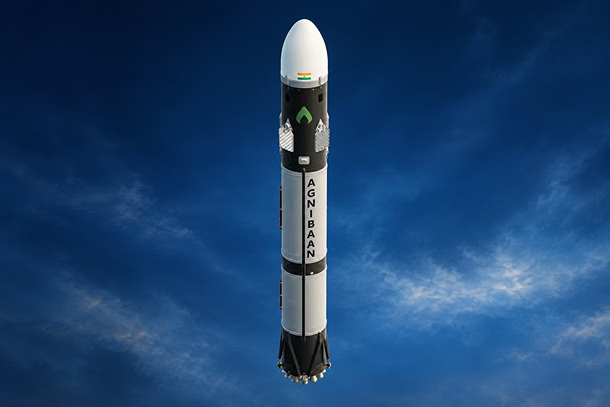
India’s private space sector is moving ahead with plans to develop reusable launch technology, with Chennai-based Agnikul Cosmos working on the Agnibaan reusable launch vehicle programme.
The Technology Development Board has committed ₹200 crore in financial support under the Research Development and Innovation Fund for the programme. The support is aimed at taking key technologies from Technology Readiness Level 4 towards Level 8.
The proposed Agnibaan reusable launch architecture is designed to go beyond recovery of only the first stage of a conventional rocket. The programme aims to develop a system capable of repeated launches and recovery.
The architecture combines a lightweight upper stage with orbital insertion capabilities and a semi-cryogenic liquid propulsion system designed for deep throttling and restart capability.
These technologies are important for reusable launch systems because the vehicle needs to control its descent and perform recovery operations after completing its primary mission.
Agnikul has already developed and tested several indigenous technologies, including its Agnibaan orbital-class launch vehicle and Agnilet engine. The Agnilet is a single-piece, 3D-printed rocket engine developed and manufactured by the company.
The new programme will involve work on propulsion, ascent systems, orbital insertion, descent and recovery technologies.
Reusable launch systems are being pursued globally as a way of reducing the cost and increasing the frequency of access to space. India’s space sector has also been encouraging private companies to develop advanced launch and satellite technologies.
The Agnibaan programme is therefore focused not only on launching small satellites but also on building technologies that could support more frequent and repeatable access to orbit in the future.


Comment here